Recently, the Supreme Court of India recognized homemakers as “nation builders.” The Court ruled that the unpaid domestic work performed by homemakers must be valued at a minimum of ₹30,000 per month when calculating legal compensation in motor accident death claims.
UPSC Online Coaching
Key Highlights of the Supreme Court Ruling
- Establishment of a Legal Floor: The Court directed the Motor Accidents Claim Tribunal (MACT) to treat ₹30,000 per month as the minimum baseline value for a homemaker’s unpaid labor.
- Motor Accidents Claims Tribunal (MACT) is a special tribunal established by State Governments under Section 165 of the Motor Vehicles Act, 1988 for adjudicating claims related to motor vehicle accidents.
- Inflation Linkage: To keep pace with economic changes, this baseline amount will automatically increase by 10% every three years.
- Dual-Income Safeguard: If a deceased homemaker also held a formal, paid job, the ₹30,000 monthly value will be awarded in addition to her regular professional income.
- Introduction of a New Damage Head: The Bench introduced “loss of domestic care” as a distinct, independent ground for awarding damages, moving beyond traditional calculation methods.
- Speedy Justice Mandate: Noting the long delays in accident cases (with the root case of this appeal dating back to 2001), the Court mandated that motor accident compensation claims should ordinarily be decided within one year.
The “Homemaker” Framework- Changing Terminology and Focus
- Language Shift: The Supreme Court emphasized the need to move away from the traditional, stereotypical term “housewife” and replace it with the more dignified and accurate term “homemaker.”
- Gender Realities: While the Bench acknowledged that men can also step into the role of a homemaker, it explicitly limited the financial quantification in this case to the traditional image of a woman.
- This decision was made to directly address the disproportionate structural burden borne by women in Indian society.
The Macroeconomic Reality of Unpaid Labor in India
The Supreme Court highlighted critical statistical data to expose the massive, uncounted economic engine driven by women:
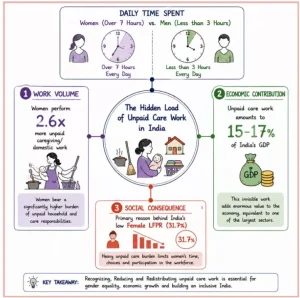
- The Time Deficit: Citing the Time Use Survey, the Court noted that women aged 15–59 spend over seven hours daily on unpaid domestic tasks, while men spend less than three hours.
- The 2.6x Care Gap: On average, women perform 2.6 times more unpaid caregiving work than men, even when they are also working formal jobs and contributing financially.
- GDP and Labor Force Impacts: Women’s unpaid care work is estimated to drive 15% to 17% of India’s GDP, yet it remains entirely uncounted in national accounts.
- The automatic societal expectation that women must handle these chores is a primary driver behind India’s low Female Labour Force Participation Rate (LFPR), which stands at 31.7%.
Constitutional Dimensions
- Article 14 (Right to Equality): Historically, courts equated a homemaker’s 24/7 care to “unskilled daily labor,” which violates the principle of substantive equality.
- Assigning a fair economic identity satisfies Article 14 by correcting this gender-biased undervaluation.
- Article 21 (Right to Life and Dignity): The right to life includes living with human dignity. Treating a homemaker’s vast emotional and structural labor as “zero income” strips away economic dignity.
- The new “loss of domestic care” head legally enforces judicial dignity for unpaid workers.
- Article 39 (Directive Principles of State Policy): This ruling aligns with Article 39(a) (right to adequate livelihood) and Article 39(d) (equal pay for equal work) by ensuring that women’s structural “double burden” (managing both home and a job) is legally and financially recognized.
Evolution of Judicial Precedents
The 2026 judgment marks the peak of a 25-year judicial evolution regarding the calculation of “notional income” for homemakers:
- Lata Wadhwa v. State of Bihar (2001): The Supreme Court recognized for the first time that the work done by a homemaker has economic value and created a method to calculate compensation based on age and other factors.
- Arun Kumar Agrawal v. National Insurance Co. Ltd. (2010): The Court rejected the idea of treating a homemaker’s income as only a small part of her spouse’s income and said this approach reflects gender bias.
- Kirti v. Oriental Insurance Co. Ltd. (2021): The Court held that the work of homemakers must be valued and ruled that they are also entitled to future prospects (increase in income considering inflation and future growth) like salaried employees.
- Arvind Kumar Pandey v. Gyanesh Pandey (2024): The Court stated that a homemaker’s value should not be calculated below minimum daily wages and should be considered at least equal to the work of a skilled worker.
Concerns and Implementation Challenges
- Limited Application: This monetization framework currently applies only to tortious liability (compensation claims for accidents and deaths).
- It does not automatically translate into a monthly salary or direct state welfare rights for living homemakers.
- Insurance Premium Pressures: Setting a high financial floor of ₹30,000 per month will significantly increase the compensation payouts borne by insurance companies, which could lead to a rise in third-party motor insurance premiums for the general public.
- A Continuous Struggle for Balance: While the ruling provides financial justice after a tragedy, it does not solve the root systemic issue- the lack of structural support (like public crèches or flexible work options) needed to relieve women of the domestic burdens that keep them out of the formal workforce.
Click to Know UPSC Offline Courses
Way Forward
- Reforming National Accounting: The Ministry of Statistics and Programme Implementation (MoSPI) should look into incorporating satellite accounts that measure unpaid care work, bringing visibility to women’s true economic contributions to India’s GDP.
- Expanding Public Infrastructure: To improve the Female LFPR, the state must build comprehensive social infrastructure, such as affordable childcare centers and elderly care facilities, to reduce the time women must spend on unpaid domestic care.
- Sensitizing Judicial and Insurance Networks: Clear, uniform guidelines must be issued to all MACT units and insurance providers to ensure the prompt, dispute-free integration of the ₹30,000 monthly floor without causing unnecessary litigation.
 12 Jun 2026